
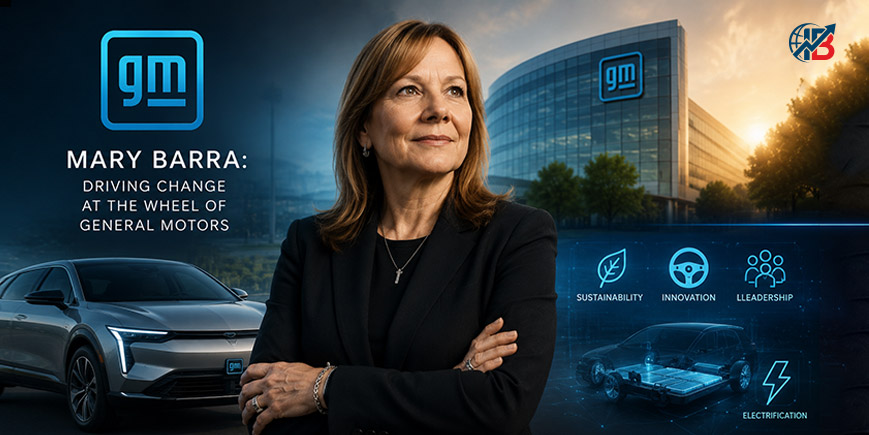
Mary Barra: Driving Change at the Wheel of General Motors
How the First Female CEO of a Major Automaker Is Navigating the Biggest Shift in Automotive History
When Mary Barra became CEO of General Motors in January 2014, she inherited a company that had just emerged from bankruptcy, was managing a bruising ignition switch recall crisis, and was facing existential questions about its relevance in an automotive industry on the edge of transformation. Twelve years later, she leads the most aggressive electric vehicle transformation in Detroit’s history, having positioned GM as one of the central players in the global race to electrify transportation.
Barra grew up in Waterford, Michigan, the daughter of a GM tool-and-die maker with 39 years at the company. She began her own GM career at 18 as a co-op student, inspecting fender panels to pay for her engineering degree at the General Motors Institute (now Kettering University). She later earned an MBA from Stanford on a GM fellowship. Her trajectory from shop floor inspector to CEO is one of the most distinctive in American corporate history.
Her first months as CEO were consumed by the ignition switch recall crisis — a defect linked to over 100 deaths that GM had known about for years but failed to address. Barra’s response became a case study in crisis leadership: she ordered a comprehensive internal investigation, testified before Congress, established a compensation fund for victims, and overhauled GM’s internal safety culture. She was direct, accountable, and did not deflect blame onto predecessors.
Once the immediate crisis stabilized, Barra turned GM toward the future. She restructured the company aggressively — exiting underperforming markets in Europe and Australia, concentrating resources on high-margin segments, and making a decisive pivot toward electric vehicles and autonomous driving technology. In 2016, GM acquired Cruise Automation, a self-driving startup, for over $1 billion. In 2017, it launched Maven, a car-sharing service.
In 2020, Barra made the most significant strategic bet of her tenure: GM committed to launching 30 new electric vehicles globally by the end of 2025 and announced plans to eliminate tailpipe emissions from all light-duty vehicles by 2035. The Ultium battery platform — developed in partnership with LG Energy Solution — was unveiled as the foundation of GM’s entire EV future. It was an $35 billion commitment that signalled an irreversible break from the internal combustion engine.
The Chevrolet Silverado EV, the GMC Hummer EV, and the Cadillac LYRIQ represent the early expression of that commitment. The execution has not been without challenges — production delays and software issues have slowed deployment — but the direction is unambiguous. GM is in a race against Tesla, Ford, and a wave of Chinese automakers for the electrified automotive future.
Barra’s leadership style is often described as calm, decisive, and analytically rigorous. She is known for asking hard questions in meetings, expecting thorough preparation, and holding teams accountable without micromanaging. Her background as an engineer gives her a credibility in technical discussions that many consumer-facing CEOs lack — she can challenge engineering assumptions from a position of knowledge, not just authority.
She has been recognized repeatedly as one of the world’s most powerful women in business, appearing on Fortune’s list for over a decade. But she consistently redirects attention from personal recognition to organizational purpose, framing GM’s transformation as a mission that matters well beyond quarterly earnings — reducing emissions, improving safety, and democratizing access to electric vehicles.
The Barra story offers a rich lesson in the marriage of operational excellence and strategic transformation. Leading a company as large and historically complex as GM through the biggest technological shift in its 116-year history requires both the discipline of an engineer and the conviction of a visionary. She is proving that those qualities can coexist — and that the incumbents, when properly led, are not necessarily destined to be disrupted.
