
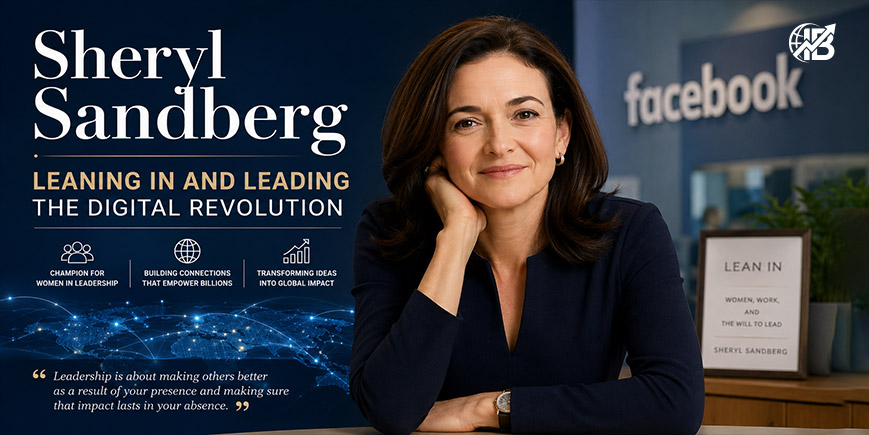
Sheryl Sandberg: Leaning In and Leading the Digital Revolution
How Facebook’s COO Became the Voice of Women in Business
Sheryl Sandberg’s career is a study in the compounding dividends of intellectual rigour, strategic clarity, and the courage to speak uncomfortable truths. As the Chief Operating Officer of Facebook (now Meta) from 2008 to 2022, she was arguably the most influential female business leader of her generation — not just for what she built at one of the world’s most powerful technology companies, but for the conversation she started about women and leadership.
Born in Washington D.C. in 1969, Sandberg grew up in Miami and graduated from Harvard College summa cum laude in economics, writing her thesis on the economic causes of domestic abuse. She returned to Harvard for an MBA, where she graduated at the top of her class. Her early career combined academic achievement with relentless practical ambition — she worked as a World Bank economist, then as chief of staff to Treasury Secretary Larry Summers in the Clinton administration.
In 2001, she joined Google, where she built and led the online sales and operations team. Under her leadership, Google’s advertising revenue grew from near zero to billions of dollars, establishing the financial engine that would fund the company’s growth for the next decade. She was by most accounts exceptional at translating complex product innovation into scalable commercial infrastructure — a skill that would prove even more valuable at her next role.
Mark Zuckerberg recruited Sandberg to Facebook in 2008, when the social network had over 100 million users but no coherent path to profitability. Her mandate was to build a business. She did exactly that, creating the advertising platform and sales organization that turned Facebook into the most valuable media company in history. By the time she departed in 2022, Facebook’s advertising revenue was approaching $120 billion annually.
Beyond the commercial achievement, Sandberg became a cultural phenomenon with the publication of ‘Lean In’ in 2013. The book argued that women systematically undermined their own professional advancement through self-limiting behaviours — sitting at the back of the room, not raising their hands, leaving jobs mentally before they left physically. She called on women to ‘lean in’ to their ambitions rather than pull back from them.
The book triggered one of the most significant conversations about gender and leadership of the decade. It was praised for naming dynamics that women recognized from their own experience, criticized for underweighting structural barriers and prioritizing individual solutions over systemic change. The debate itself — intense, global, and ongoing — was arguably the most valuable outcome. Sandberg had made gender equity a mainstream business discussion.
She further demonstrated vulnerability and grace when, in 2015, her husband Dave Goldberg died suddenly while on a family holiday in Mexico. Her public writing about grief — shared on Facebook and later published in the book ‘Option B’, co-authored with psychologist Adam Grant — was extraordinary in its honesty and became a resource for millions of people navigating loss.
Sandberg departed Meta in 2022 after 14 years, having built an institution, started a movement, and modelled a form of leadership that balanced ambition with humanity. She has since focused on philanthropy, particularly through the Sheryl Sandberg & Dave Goldberg Family Foundation, which focuses on women’s empowerment and building resilience.
Her career offers a nuanced lesson for leaders: commercial excellence and cultural influence are not separate lanes. Building a great business and contributing to the broader conversation about how we organize our working lives are complementary acts. Sandberg proved that a COO could be both a world-class operator and a genuine shaper of social thought — and that those two identities, far from being in tension, could amplify each other.
