
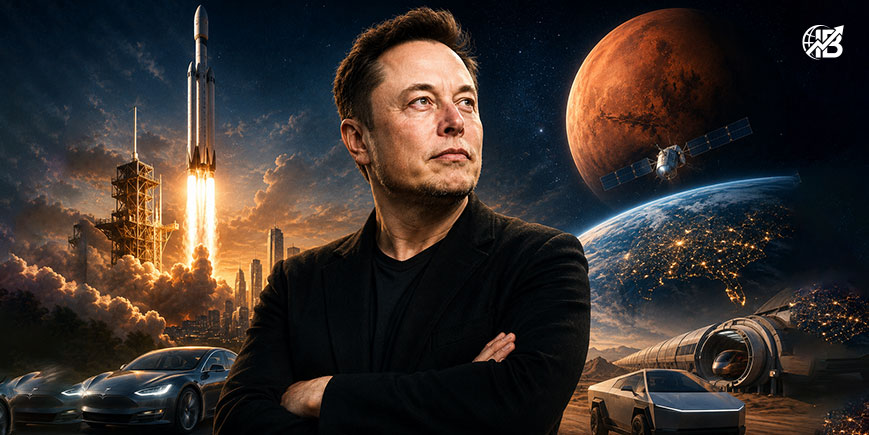
Elon Musk: The Visionary Who Refused to Accept Limits
From Bankruptcy to Building the Future
There are entrepreneurs, and then there is Elon Musk. The South African-born innovator has built not one but several world-changing companies across industries most people consider impossible to disrupt — automotive, aerospace, and energy. His story is one of relentless conviction, brutal setbacks, and a refusal to accept the boundaries others see as permanent.
Born in Pretoria, South Africa in 1971, Musk showed an early obsession with technology and science fiction. At 12, he sold a video game he had coded himself. At 17, he moved to Canada and eventually transferred to the University of Pennsylvania, earning degrees in economics and physics. He then enrolled in a Stanford PhD program — and dropped out after two days to start his first company.
That company, Zip2, was a web-based city guide software firm, which he sold to Compaq in 1999 for nearly $300 million. Musk then co-founded X.com, an online payments company that later became PayPal. When eBay acquired PayPal in 2002 for $1.5 billion, Musk walked away with $165 million — and immediately set his sights on something far more audacious.
He founded SpaceX in 2002 with the goal of making humanity a multi-planetary species. What followed were years of failure. The first three launches of the Falcon 1 rocket failed. Musk had poured nearly all his personal fortune into SpaceX and Tesla, and both companies were on the verge of collapse in 2008. In an interview, he recalled crying on the floor while others around him doubted everything. The fourth launch of Falcon 1 succeeded, saving the company and changing history.
Tesla, co-founded in 2003 (though Musk joined shortly after), similarly faced near-death. Production delays, cash shortages, and critics who called electric vehicles a fantasy plagued the company for years. Today, Tesla is the most valuable automaker in the world, having transformed the global automobile industry and accelerated the transition to sustainable energy.
Musk’s leadership philosophy is distinct and often controversial. He demands intensity, sets seemingly impossible deadlines, and leads by example — famously sleeping on Tesla factory floors during production crises. He is known for his first-principles thinking: breaking down complex problems to their fundamental truths and rebuilding solutions from scratch, rather than relying on analogy or convention.
Beyond Tesla and SpaceX, Musk’s ventures include The Boring Company (underground transit), Neuralink (brain-computer interfaces), and his acquisition of Twitter (rebranded X), all reflecting his belief that technology can solve humanity’s deepest challenges.
What makes Musk’s story particularly instructive for business leaders is not just the success — it is the willingness to bet everything on a vision most considered crazy. At his lowest point in 2008, he had enough money to fund either SpaceX or Tesla for one more round, not both. He split it between them. That decision, driven by conviction rather than caution, defined the trajectory of two entire industries.
His lesson for aspiring entrepreneurs is stark: the gap between a visionary and a dreamer is execution under pressure. Ideas are common. The capacity to persist through failure, adapt with speed, and maintain clarity of purpose when everything is collapsing — that is what separates the builders of the future from the rest.
