
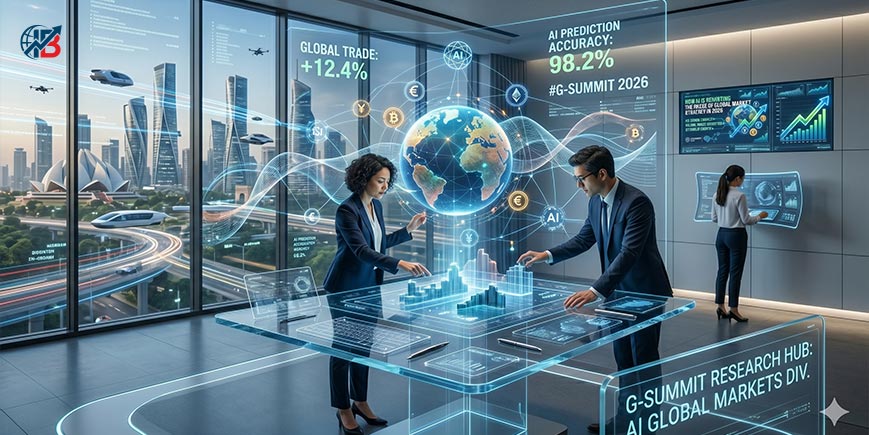
How AI is Rewriting the Rules of Global Market Strategy in 2026
Artificial intelligence is no longer a futuristic concept reserved for tech giants. In 2026, it has become the backbone of how businesses across the globe design, execute, and refine their market strategies. From predictive analytics to autonomous decision-making, AI has fundamentally altered the competitive landscape.
Companies that once relied on quarterly reports and gut instinct are now operating in real-time. AI-driven platforms can scan millions of data points — social sentiment, competitor pricing, supply chain shifts, and consumer behavior — and deliver actionable insights within seconds. The result? Faster pivots, smarter investments, and dramatically reduced risk.
Take the retail sector as an example. Global brands are now using AI not just to recommend products but to predict demand at hyper-local levels. A clothing company in London can now identify a trend emerging in Mumbai before it reaches mainstream awareness, adjusting its inventory and marketing campaigns weeks in advance.
In the B2B world, AI is transforming customer acquisition. Instead of broad, expensive campaigns, companies are deploying machine learning models that score leads with extraordinary precision, directing sales teams toward prospects most likely to convert. This has not only improved close rates but also reduced the cost of customer acquisition by up to 40% in some industries.
Market strategy itself is evolving. Traditional SWOT analyses are being replaced by dynamic competitive intelligence dashboards that update continuously. CEOs and CMOs can now simulate hundreds of strategic scenarios before committing a single dollar to execution.
However, the rise of AI in strategy is not without its challenges. Data privacy regulations, algorithmic bias, and the risk of over-automation are real concerns that business leaders must navigate carefully. The most successful organizations are those that combine AI capabilities with human judgment — using machines to process and predict, while relying on people to interpret, empathize, and innovate.
The future of global market strategy belongs to businesses that treat AI not as a tool but as a strategic partner. Those who embrace this shift today will define the markets of tomorrow. The question is no longer whether to adopt AI — it is how fast and how wisely you do it.
