
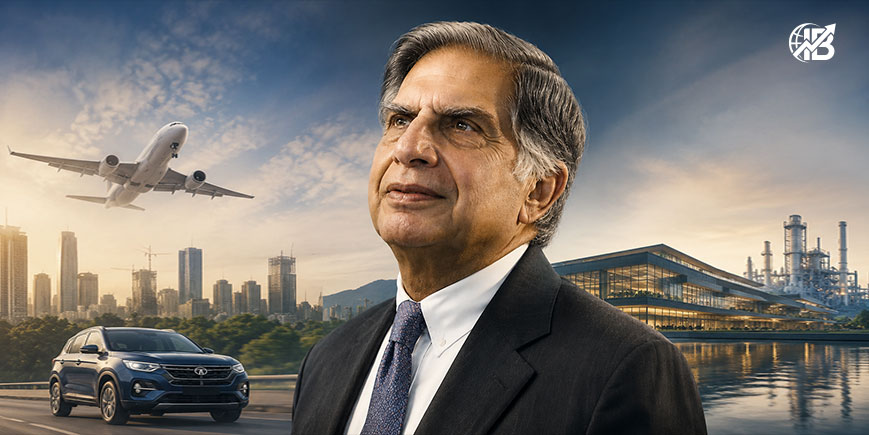
Ratan Tata: The Gentleman Who Built a Global Legacy
Leading with Integrity in One of the World’s Oldest Conglomerates
In a business world often defined by self-promotion and controversy, Ratan Tata stands apart. The former chairman of Tata Sons—the holding company of one of India’s most storied conglomerates — is widely regarded not only as one of the most consequential business leaders of his generation, but as one of the most admired human beings in the history of Indian industry. His legacy is inseparable from the values he modelled throughout his career: humility, integrity, empathy, and a commitment to nation-building.
Born in 1937 into one of India’s most distinguished families, Ratan Tata was raised primarily by his grandmother after his parents separated. He studied architecture at Cornell University and later attended the Advanced Management Program at Harvard Business School. When he returned to India, he chose to begin at the bottom — working on the shop floor of Tata Steel rather than entering senior management. The experience shaped his understanding of the business from the ground up.
He was appointed chairman of Tata Sons in 1991, at a moment of profound uncertainty. India was just beginning to liberalize its economy, and the Tata Group — a sprawling conglomerate with over 80 companies — needed transformation. His predecessors had built an institution of remarkable breadth; Ratan Tata’s challenge was to rationalize it for the global competitive era while preserving its soul.
His tenure as chairman was defined by bold acquisitions that transformed Tata from an Indian conglomerate into a global corporation. The purchase of Tetley Tea in 2000 was the first major acquisition of a foreign company by an Indian firm. Corus Steel followed in 2007, and then, most dramatically, the acquisition of Jaguar Land Rover from Ford in 2008 for $2.3 billion — at the height of the global financial crisis, when most executives were retreating.
The JLR acquisition was initially met with skepticism. Many questioned whether an Indian company could revive two iconic but struggling British luxury automotive brands. Under Tata ownership, both brands flourished. JLR became one of the most profitable divisions of the Tata Group, known globally for design excellence and engineering quality. The acquisition became a case study in post-merger value creation.
What was equally remarkable about Ratan Tata’s leadership was what he did not do. In an era of celebrity CEOs, he shunned the spotlight. He lived modestly. He owned few personal luxuries despite immense personal wealth. When the 26/11 Mumbai terrorist attacks targeted the Taj Mahal Palace Hotel — a Tata property — he appeared personally at the hotel within hours, met with staff and guests, and personally oversaw reconstruction and welfare payments to affected employees. It became a defining symbol of Tata’s commitment to people over profit.
The Tata Group’s structure is itself a reflection of its values: two-thirds of the equity of Tata Sons is held by philanthropic trusts, meaning the majority of corporate profits flow into charitable causes including hospitals, educational institutions, and rural development programs. This structure, established by the group’s founder Jamsetji Tata in the 19th century, was maintained and honoured by Ratan Tata throughout his tenure.
Ratan Tata passed away in October 2024, and the outpouring of grief from across India and the global business community was extraordinary — a testament to the depth of the connection people felt with a man who had led not through authority but through example.
His greatest lesson for today’s leaders is that the currency of trust is far more durable than the currency of money. In a world where corporate scandals make headlines weekly, Tata built an institution that generations of Indians regarded not merely as a business but as a national asset — one that could be relied upon to act with honour even when no one was watching.
